







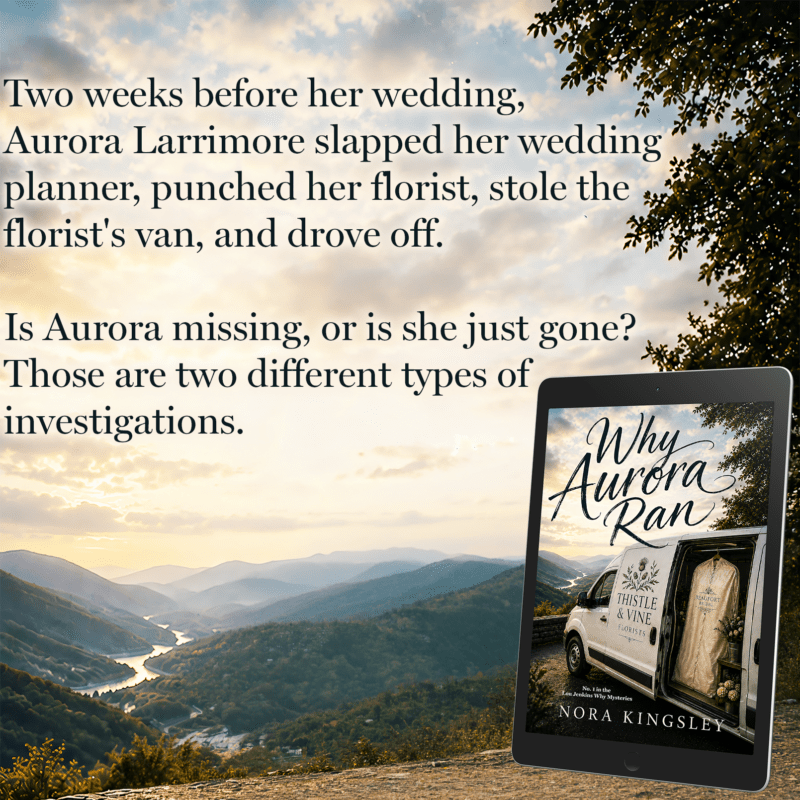
Two weeks before her wedding, Aurora Larrimore slapped her wedding planner, punched her florist, stole the florist’s van, and drove off.
Is Aurora missing, or is she just gone? Those are two different types of investigations.

Why Aurora Ran
The Lou Jenkins WHY Mysteries No 1
by Nora Kingsley
Genre: Mystery

Two weeks before her wedding, Aurora Larrimore slapped her wedding planner, punched her florist, stole the florist’s van, and drove off.
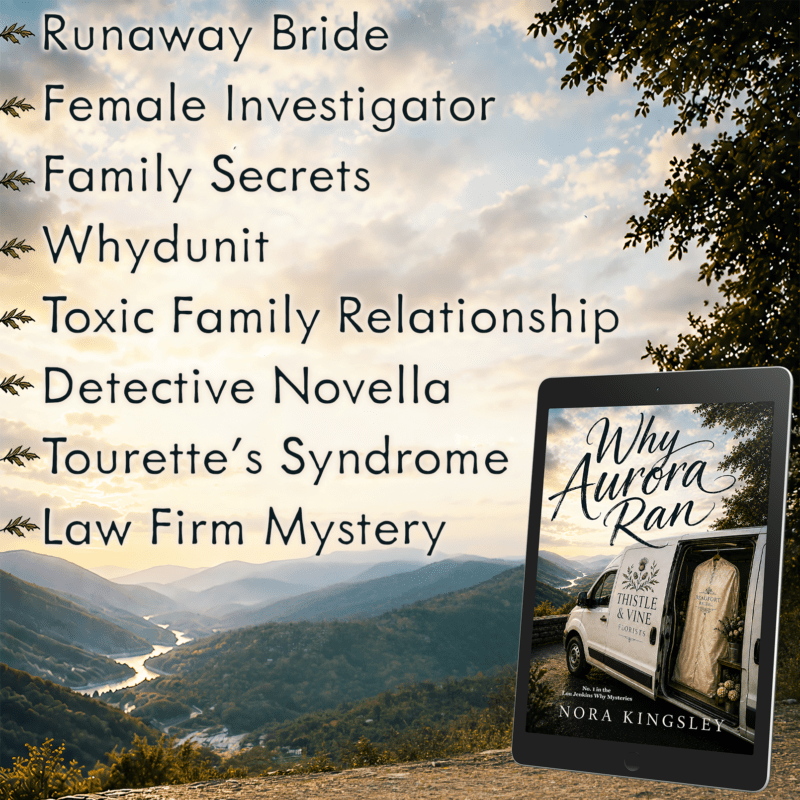
Her family calls her unstable. Melissa “Pissy Lou” Jenkins isn’t convinced. A blunt, brilliant skip tracer for the family’s law firm, Pissy Lou notices what everyone else misses, and her Tourette’s has a habit of announcing exactly what she thinks of the people she questions. She is sent to find Aurora in time to save the wedding, and she starts with the question nobody else asked: is Aurora missing, or is she just gone? Those are two different types of investigations.
Her interviews turn up stories about a controlling mother, a fiancé whose answers don’t fit, and a carefully polished lie the whole family seems to be protecting. Before Pissy Lou can find the runaway bride, she has to answer the question at the heart of the case. Everyone involved in the wedding has a theory about Aurora, but Pissy Lou is the only one asking why she ran.

Chapter 4
Vendors and a Client
Pissy Lou was at her desk by eight the next morning. She poured her yellow-orange mug full of iced coffee and opened her notebook to a fresh page. The Larrimore file was open in front of her. She had a list of calls to make before she drove out to Devereaux Heights, where Richard and Celeste Larrimore lived. She had verified information on the people she had intended to talk to the day before.
First on her list was the caterer, a woman named Darlene Puckett who ran the Fork & Flourish out of a commercial kitchen on the east side of town. Ms. Puckett answered on the second ring.
After introductions, Pissy Lou got down to work. “What did you do when Celeste Larrimore called to change the menu for the wedding?
“I told Aurora everything,” Puckett said. She had the tone of a woman who was waiting to talk about this situation. “As soon as I realized what her mother was doing, I called Aurora directly. I did not care whose toes I stepped on. It is her wedding.” She paused. “That woman, Celeste Larrimore, called me four times in two weeks. She wanted to swap out the entire menu. Aurora and Hayes had tasted everything; they’d signed off on a menu, and we had a contract. The menu was set. Then here comes Celeste wanting another tier on the cake, to swap out the wedding topper, and then she wanted chicken marsala and salmon added to the menu. She said Aurora was ‘too informal’ in her choices, like it was a character flaw.” Another pause, a deliberate one. “I have dealt with a lot of difficult mothers of the bride. That woman is in an extra-obnoxious category by herself.”
Pissy Lou thanked her and moved on.
The printer, a slow-talking man who identified himself only as “Bill, from Printed to Perfection,” confirmed the invitation situation, Aurora and Hayes had selected a plain card with an elegant texture, letterpress printing, a classic Garamond font, and wording that named them both first and their parents second. Celeste had called and instructed him to change the wording so that it read: “Mr. and Mrs. Richard Larrimore request the honor of your presence at the marriage of their daughter …” which was not what Aurora had ordered, and not what was on the signed proof. Celeste provided her credit card, so he did a second run with the new wording. He then emailed the new proof to Aurora. She called back and sounded angry. She told him to throw those out, and hoped he still had the original invitations. He did. She also made him promise to call her again if Celeste tried to change them again.
“This happens more often than you might think,” Bill said in his deadpan way. “Parents argue about wording. Grandparents argue about wording. I once had a bride’s aunt threaten to sue over cardstock. That is why I never throw invitations away until after the wedding. Somebody is always upset about something.”
“Was this unusual?” she asked.
“As I said, no, happens all the time. But this was a bit new, Aurora wanted me to call her personally if her mother contacted me again. I mean the woman got caught the first time. Why would she try it again?”
Pissy Lou’s call to BarbyAnne Knowles, the events coordinator at the wedding venue, was more involved. Aurora and Hayes had booked The Carrington, an estate property outside of town with a bridal ceremony and reception space, gardens, and a catering kitchen. Celeste had called The Carrington and, citing unspecified “concerns,” canceled the booking, then booked a different property, Magnolia Hall, which had a more formal aesthetic. Pissy Lou suspected this site had a greater prestige among the circles Celeste traveled in. Aurora had called The Carrington, discovered the cancellation, and re-booked it immediately.
“I was surprised at how calm Aurora was. If my mother had pulled that on me, I would have been swearing something awful,” BarbyAnne said. “Then she asked that no further changes be accepted from anyone other than herself, and that such changes had to be in writing. I could tell she had thought this out before she called. I have never had another bride who had to ask me to do th Her last vendor call was to Beaufort Bridal, the shop where Aurora’s gown had come from. The owner, Serafina Beaufort, ran the store her grandmother had opened and had been dressing Nunenberg brides for over forty years. She remembered the gown without having to look anything up.
“Aurora picked an ivory, sleeveless couture gown, clean lines, no fuss. It had a slightly uneven hem, and ended just above her ankles so she could move easily. It suited her perfectly, and she knew it the minute she had it on. You can always tell,” Serafina said. “And she had an eye, that girl. She chose all four bridesmaids’ dresses here too — peacock blue, midcalf, with three-quarter sleeves of ivory illusion lace, and little flowers embroidered into the lace in the same blue, so they seemed to bloom right on the skin. Each one was cut a little differently, but you could see at a glance they belonged together. Those women came to their fittings laughing, and every single one asked me if she could wear hers again afterward. In this business, that is the highest compliment there is.”
“And the bride’s gown?”
“Then the alterations started.” Serafina Beaufort paused before continuing. “Her mother ordered the changes directly, four separate times, and mostly between fittings, so Aurora never saw them coming. Lace sleeves. A higher neckline. Lace layered over the bodice. She addeda train and veil. Mrs. Larrimore was paying for the work, so my hands were tied, but every fitting, that poor girl came in and found less of her own dress waiting for her. At the last one she said something about us turning it into a lacy burka. One of my fitters laughed. I did not.”
“Four rounds of alterations,” Pissy Lou said. “Is that normal?”
“Honey, in forty years I have taken gowns in, let gowns out, and re-beaded an entire bodice overnight for a bride who changed her mind. I have never un-designed a dress four times for a woman who was not the one wearing it.” She paused. “I heard Aurora took the gown with her when she left. Good. She should burn it. I’ve unpicked a lot of mistakes in forty years, but that gown’s got four rounds of her mother sewn in too deep for any seam ripper. Fire’s just the last alteration, and it’s the only one her mother can’t reverse.”
“So, you think Aurora intends to burn the dress?” Pissy Lou asked.
“Honey, if that were my dress, I’d pour a can of gasoline on it and strike a match,” Serafina said without hesitation.


Nora Kingsley lives on Cape Cod in Massachusetts, where the landscape, the weather, and the Atlantic provide a constantly changing backdrop for an active imagination. Why Aurora Ran is Nora Kingsley’s debut and the first in the Lou Jenkins mystery series.
A lifelong reader, Nora is happiest wandering through historical fiction, mysteries, science fiction, and fantasy, especially books that offer a compelling world, an intriguing puzzle, or characters worth following well past bedtime. Her interests extend beyond the page to music, movies, cooking, and art, and she has always been drawn to the many different ways people create and tell stories.
She shares her life with the people and animals she loves, an unreasonable number of interests, and the firm conviction that there is always room for another book.

A quick note before I get into Lou’s Tourette’s: she isn’t the first fictional detective to have it. Jonathan Lethem’s Motherless Brooklyn, published in 1999, is an award-winning neo-noir novel featuring private investigator Lionel Essrog, who has Tourette syndrome. It was also adapted into a film starring Edward Norton. I haven’t read the book yet, so Lionel wasn’t an influence on Lou, but I recently got a copy and will be reading it shortly.
When writing about Lou’s Tourette’s, I did my research but I am sure there are things I got wrong. Her mother, Augusta, helped her learn ways to cope with it, but Tourette’s is different for everyone. Sometimes what comes out of Lou’s mouth is coherent and sometimes it isn’t. It’s part of Lou, but it doesn’t define her. In Chapter 3, while interviewing Hayes Merritt, she says something off-color and then thinks: “My apologies. I meant nothing by it. Tourette’s,” she said. I had no idea I was going to say that but I did. Wow. One of the few times I agree with the rando shit that comes out of my mouth. This guy is a damn stinker, as Grandma used to say.
The involuntary swearing associated with Tourette syndrome is called coprolalia, and despite the stereotype often shown in movies and on television, it affects only about 10–15% of people with Tourette’s. Tics can be vocal, such as sniffing, throat clearing, grunting, or words and phrases, or motor, such as blinking, shrugging, twitching, or sudden movements. The tics are involuntary and don’t necessarily reflect someone’s thoughts or beliefs. Some people can suppress them temporarily, but that takes effort and can create a buildup that leads to stronger tics later.
I explored this in Chapter 6: Celeste Larrimore, when Lou barely makes it back to her car after holding her tics in through a tense interview. Once the door closes, the pressure breaks: she rocks, pounds the steering wheel, and unleashes a string of rhyming insults until she’s nearly crying with relief.

Follow the tour HERE for special content and a giveaway!
Sep 15
Kickoff at Silver Dagger Book Tours
Sep 16
Sep 17
Sep 18
Sep 19
Sep 21
Lisa Book Krewe – GUEST POST
Sep 22
Sep 23
Sep 24
Sep 25
Sep 26
Tina Donahue Books – Heat with Heart
Sep 28
FUONLYKNEW – GUEST POST
Books all things paranormal and romance
Sep 29
Sep 30
Inside the Insanity – GUEST POST
Oct 1
Oct 2
Oct 3
Oct 4
WMC Book Corner – YouTube channel
Oct 5
Oct 6
Oct 7
Book Bites….with a side of coffee
Oct 8
Oct 9
Stormy Nights, Books and Blogging
Oct 10
Oct 12
Oct 13
Oct 14
Oct 15











Sounds like a good story. Maybe the fact that no one is asking ‘why she ran’ is because they know, but don’t care.
Looks very exciting