



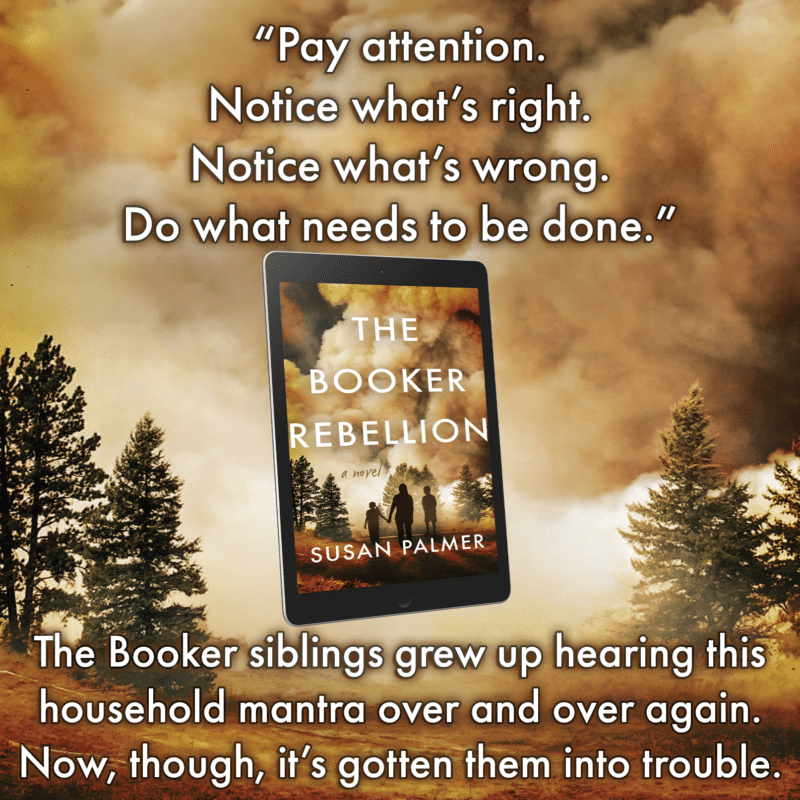
“Pay attention. Notice what’s right. Notice what’s wrong. Do what needs to be done.”
The Booker siblings grew up hearing this household mantra over and over again.
Now, though, it’s gotten them into trouble.
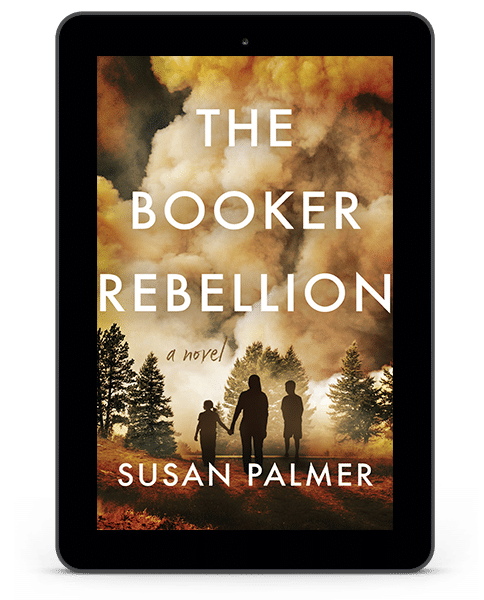
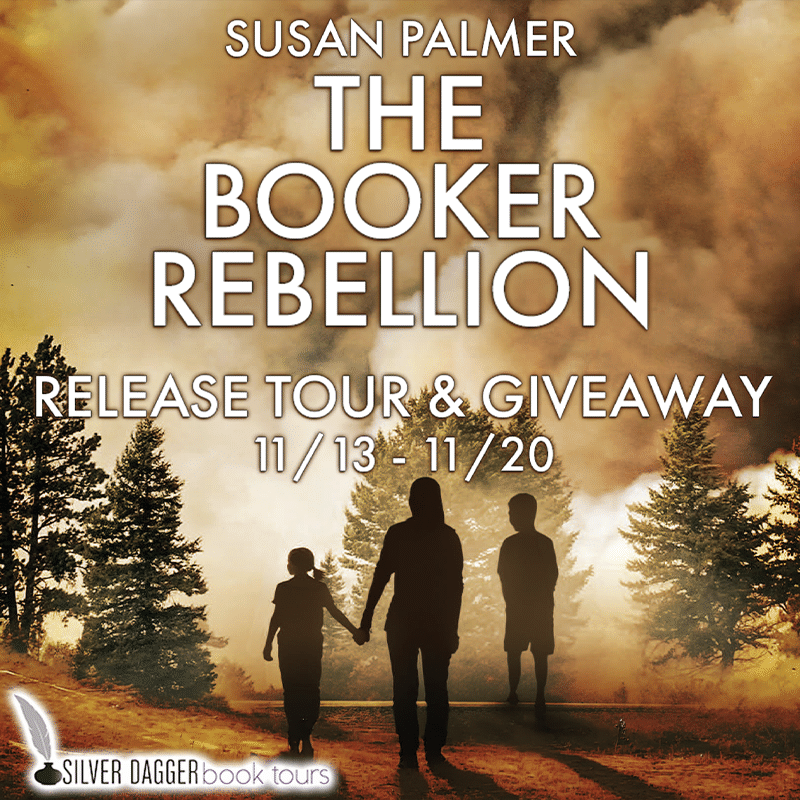
The Booker Rebellion
by Susan Palmer
Genre: Survival Thriller

A modern wilderness thriller in the tradition of True Grit
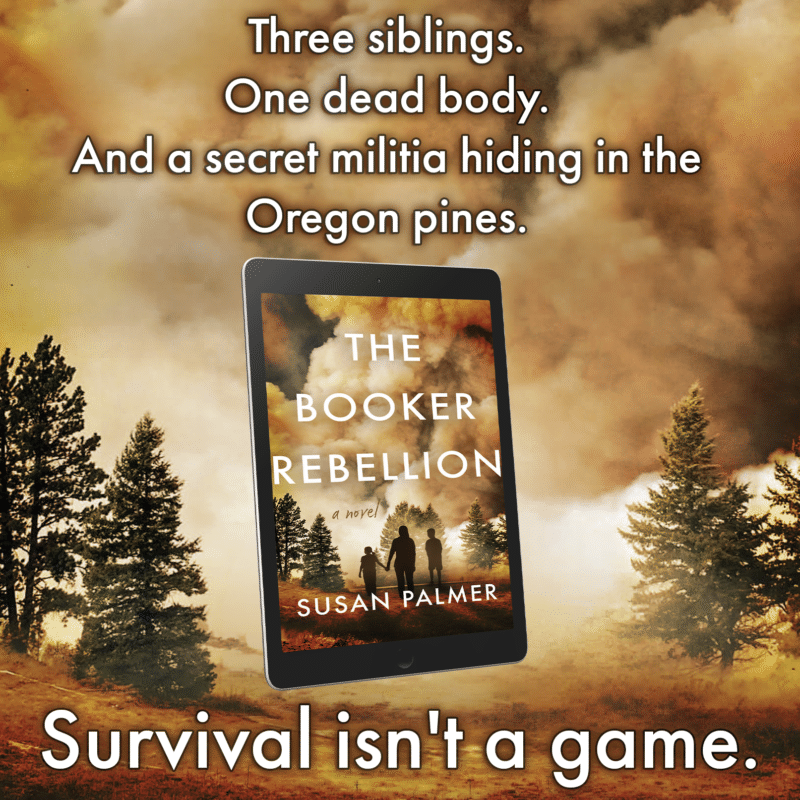
Belinda Booker and her siblings Jack and Emmy know the forest around their remote Oregon home intimately, so they’re bound to notice when things change—big trees cut down, motorcycle tracks on trails meant for people, a stash of cash hidden under a log. Then they stumble on a dead body. With parents fighting wildfire thousands of miles away and a withered caretaker aunt at home, they call in a sheriff’s deputy. That’s their first big mistake. The aunt goes missing, and the Bookers will need all their woodcraft to rescue her and stop a secret militia training to seize the national forest headquarters. Home is no harbor. And wildfire is coming.
Praise for The Booker Rebellion
“The Booker Rebellion is a fresh, exciting adventure, a book that moves as fast and clear as a mountain creek. Susan Palmer knows the landscape of the Oregon Coast Range intimately, and she brings to the page all the beauty and danger of that country in rich detail, without slowing the wild ride for a moment. I couldn’t stop reading.”
—Molly Gloss, award-winning author of The Jump-Off Creek and Wild Life
“Superbly drawn characters, nonstop action. Highly recommended.”
—Elizabeth Engstrom, author of The Itinerant
“A thrill-seeker’s thriller with head-smacking surprises, gritty wisdom,
fierce resilience and fiercer love at every turn.”
—Paul Neville, author of The Garbage Brothers
Amazon * Bookshop.org * Bookbub * Goodreads

Belinda pulled a folding knife from her back pocket and flicked it open. She dared not use her flashlight. Something brushed against papery ferns. A twig snapped. Her heart hammered. Deer? Bear? Human? And then a waiting silence. Belinda tried to calm her breathing, but it hitched faster. She was on the point of panic when her dad’s voice came to her, calm and deep, saying: “Fear’s the wake-up call, Beebee. That’s your body alerting you. But you don’t leave the alarm on once it wakes you up. You shut it off and turn everything else on. All your senses. And you deal with whatever.”
She pulled herself together, sank down, and felt for a stout branch, finding only soft duff. She inhaled, held the breath deep in her lungs, stood slowly, well off the path, knees loose, hands ready. Then a rough voice from upslope yelled, a rebel yell, whooping, powerful. The motorcycle engine snarled alive and bouncing light threw tree shadows everywhere. Belinda stepped closer to a big tree as the motorcycle light cut across the path. The bike roared past, and then she was tackled, knocked to the ground, her knife hand trapped under her back, which she arched to avoid cutting herself. She squirmed out and jumped to her feet, preparing a swinging kick before a coughing voice snarled, “Jeez, Belinda, notch it down!”
“What the hell?” she demanded, gasping.
“Gunshots. I heard gunshots,” Jack said as he pulled himself to his feet. “Two, maybe three. Large-caliber pistol.”
“No way,” Belinda said.
“You mean that’s not what woke you up?” Jack said and then grabbed her arm. “Don’t tell me you know those guys.”
“Of course not!” Belinda said. “I heard the motorcycle engine. But I didn’t hear any gunshots.”
“So you heard the bike and you thought you’d check it out? I bet you thought it was that guy from school.”
“And you’re telling me you heard gunshots in the middle of the night? What’d you think you’d do? Come out here and scold them to death?
“My job is watching the perimeter,” Jack said. “I was watching the damn perimeter.”
Belinda de-escalated. “You want to follow them or go home?”
“Go home,” Jack said. “That motorcycle track isn’t going anywhere. We can see it better in daylight.”
Belinda pulled her flashlight out and pointed it down, enough illumination to see the ground in front of them. The motorcycle’s noise had quickly faded to nothing as it rounded the ridge below them.
As they walked, she faced a thought she’d been circling for days. They lived with a frail old woman who could do little more than dial the phone if something bad were to happen. Out here, bad was big. A windstorm could knock a tree down on their house or take out the power line. A mudslide could engulf them. A wildfire could burn them out. Bad people could rob them. Emmy could wander off and get lost in the woods. Belinda ran through the catalog then stopped abruptly when Jack put a hand on her arm. They both heard the scrabbling, scratching sounds. Belinda raised the light. In a narrow clearing, a cougar stood over a carcass, a small one about thirty feet away. Her light flickered over it and she realized how amped she must have been when she came this way and hadn’t smelled it, the raw red death smell. The cougar didn’t stop feeding, its yellow cat-eyes on them, unafraid.
Jack knelt, felt around, and picked up a stone. He threw it at the cougar, which hissed then grabbed the carcass and faded among the trees.

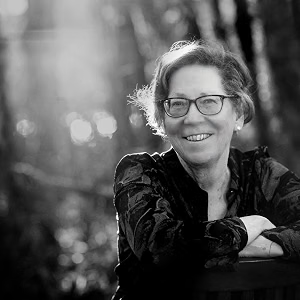
Susan Palmer is a multiple award-winning Oregon journalist and fiction author whose short stories have appeared in Sunstone magazine and anthologies including Imagination Fully Dilated. Her first novel, The Tabernacle Bar, was set in Northern Utah’s high country. Her new thriller, The Booker Rebellion, brings Oregon’s Coast Range to vivid life. A hiker, birder, and embroiderer, she is also a licensed ham radio operator who once bounced her voice off the moon. She lives in Eugene, Oregon, with her husband who is far more competent at ham operations.
Website * Facebook * Facebook * X * Instagram * Instagram * Bluesky * Amazon * Goodreads

Can you, for those who don’t know you already, tell something about yourself and how you became an author? I snuck into writing through the back door of a newspaper. I got hired to write obituaries, and I fell in love with the immediacy of daily journalism. After a while, an editor let me write the occasional short news story. And after a still longer while, I was hired as a full-time reporter. After about a decade working as a journalist, I wrote my first novel, The Tabernacle Bar.
Tell us something really interesting that’s happened to you!
During my years as a reporter at the Anchorage Daily News in Alaska, I went to Utqiaġvik (the village formerly known as Barrow), which sits at the juncture of the Chukchi and Beaufort seas. I was writing about and traveling with three trombonists from the Washington D.C. National Symphony Orchestra who were doing music workshops with high school students around the state. While we were there, the community’s only taxi driver—who had an old Cadillac that had seen better days—took me and the trombonists out to the garbage dump, which was billed as a great place to see polar bears. On the way, the driver told us about the time the car had broken down and her riders had to walk back to the village center, a trip of about two miles. In polar bear country. We ourselves did not see polar bears at the dump that day. But the car didn’t break down either.
Where were you born/grew up at?
I’ve been a bit of a wanderer. I was born in Canada, in Saskatchewan, one of the prairie provinces that looks a lot like the flatlands of eastern Montana. I moved at a pretty young age to Toronto—imagine Chicago, a big beautiful city on a massive lake. When I was twelve, my family moved to a university town high in the Andes Mountains of Venezuela. After that, we did a year in a small village near the north coast of Colombia. I finished high school in northern Utah and have lived the rest of my life in various places in the western United States. I’m a dual citizen of Canada and the U.S.
What do you do to unwind and relax?
I love a good road trip on two-lane highways that run through small towns. My longest road trip took about six weeks. I started in Anchorage and drove south to Albuquerque, then headed northwest to California and up through Oregon and Washington before returning to Alaska. I wandered a lot, covered about 11,000 miles. I recently made a run from my home in Eugene, Oregon down to Petaluma, California that took me through the majestic redwoods of the northern California coast.
A lesser-known tree on that route that I came to admire is the massive Tasmanian blue gums, a kind of eucalyptus that is among the tallest nonnative trees in the United States. They’re beautiful, with narrow gray-green leaves and bark that peels away in long strips. They have an interesting saddish back story. They were imported from Australia after the California gold rush by investors hoping their quick growth would make for a profitable lumber business in the fast-growing state. But the lumber from the young trees twisted and split and was essentially unusable for construction. And this is a great example of why I love a good road trip. It excites my curiosity when I see something I know nothing about and feel compelled to learn. A month ago I knew nothing about Tasmanian blue gums. Now I’m itching to work them into a story.
What literary pilgrimages have you gone on?
About a decade ago, I was a broken-hearted mess and I was desperate for a change of scenery. I remembered an author I had adored as a teenager, Mary Stewart, who was famous in her day for romantic mysteries set in exotic places. One of her books I particularly loved was Nine Coaches Waiting. It was set near a Thonon-les-Bains in France. It’s in the Alps near the Swiss border, not far from Geneva. I took my sad self there and spent two beautiful weeks. And I thought a lot about Stewart and how she was so genius in bringing amazing landscapes alive along with her characters. I still go back to her books now and then, and I’m glad to have walked on the streets of a place she described.
What inspired you to write this book?
I began thinking about the book that became The Booker Rebellion after spending time with my young nieces and nephews when they were deep into the Harry Potter books, and so I jumped into them as well. Author J.K. Rowling built this amazing magical world that you didn’t really want to leave when the books ended. And I found myself wondering if it could be possible to write something that magical and compelling but set in the real world. I wanted it to be adventurous and dangerous but beautiful and rich, too, and with young characters who had real-world skills to meet the dangers they faced. Of all the places I’ve lived and visited, the old-growth forests of Oregon not far from my home are the most magical real-world places I know. If you’ve ever seen those big trees right after a rainstorm with drops clinging to them when the sun comes out, it’s hard to describe adequately. Sunlight turns the drops to diamonds and the trees just shimmer. Or lit by full moonlight on an otherwise deep dark night. And then there are the waterfalls, and the streams, and the playful otters and, yes, the people who wish others ill. I know Rowling’s public positions on transgender have been offensive. But her Harry Potter books are beloved and they inspired me on my own journey to this book.
What can we expect from you in the future?
I have a novel coming out in March 2027, Blue Coast in Winter. It’s a literary thriller set on the French Riviera in a little town called Cassis. It’s a stunning place with dramatic cliffs rising above a tiny harbor, vineyards on the slopes, hiking trails skirting narrow aqua bays that must be seen to be believed. It’s a place I’ve visited a few times and would love to return to. I set a novel there because I didn’t want to leave Cassis behind. That book is finished, and now I’m writing the sequel to The Booker Rebellion, The Booker Escape. I’m in that exciting place in the sequel where I think I know what’s going to happen, but somehow things shift in the writing and the story veers in unexpected directions. It’s the most joyful creative part of the writing process.
What are your top 10 favorite books/authors?
My favorite books and authors shift regularly because I read a lot and fall deeply in love with a new-to-me author several times a year. Here’s my current top 11 books (sorry!) in no particular order.
A Tale for the Time Being by Ruth Ozeki. This book enchanted me because of the relationship that builds between two people who never actually meet. It’s such a story of the heart I can’t let it go.
The Hearts of Horses and Falling from Horses by Molly Gloss. These two books are quietly, hauntingly beautiful in their depiction of rural life. She writes hard landscapes and tough problems and yet I feel so enriched and uplifted in reading them.
A Wizard of Earthsea by Ursula K. Le Guin. Actually, all the Earthsea books bring me great pleasure. I love the watery island world she conjures. I love the story of a young wizard’s great power, great error and great transition. I can read these books again and again.
The Ministry of Time by Kaliane Bradley. When I read the book, I found the ending so unexpected that I immediately started reading it again to see if Bradley had put the seeds of the ending earlier in the book. She had. The first seed was on the first page. What a deft hand she has as a writer. Goodness.
All the Light We Cannot See by Anthony Doerr. The book describes the strange hard road between two young people whose worlds are torn by war and yet they are linked by an invisible thread. Maybe I love this book because I am an amateur radio operator with a technician’s license and I can imagine myself tuning across the airwaves for music that eases my heart.
Desert Solitaire by Edward Abbey. This book taught me to love landscape in a way I hadn’t ever thought about. It made me see myself as part of the landscape, not apart from it. Abbey’s book opened a door into myself I hadn’t previously known was there.
Smiley’s People by John Le Carré. I’ve read this book so many times. It’s top-of-the-line suspense writing, but Le Carré makes his prose do double duty. He gives a physical description of a person that also conveys personality. He starts a scene in a surprising place, not at the plot’s hub, but spiraling toward it. And he knows how to craft a fine sentence. He’s some kind of magician as a storyteller.
The Polish Officer by Alan Furst. This is just one of many of Furst’s historical spy novels set in pre-World War II Europe. But these novels start with a person who gets drawn into the clandestine world, not a professional secret agent. The story of spying, of a secret agency’s stratagems, their successes and failures, that is backdrop to the protagonist’s on-the-ground experiences. The protagonist is the heart of the story and of all Furst’s books I like The Polish Officer best.
The Milagro Beanfield War by John Nichols. The characters are so funny-broken-valiant-misguided, the injustices of the wealthy so true, the fight for water in a dry landscape so high-stakes. All of that makes me wish it were a real place and I could really go there and join the battle for justice.
His Majesty’s Dragon by Naomi Novik. Historical fantasy? Really? The Napoleonic Wars reimagined with dragons should absolutely not work for me. But it does. This is a dumb metaphor but Novik breathes fire into every bit of the story and I didn’t want to bow out at the end. There are many books in the series and not all held me, but this one I do come back to.
Wolf Willow by Wallace Stegner. There is no other memoir in the world like this one. Stegner’s description of the years his family spent living in Saskatchewan (where I was born) merge with the significant history of that landscape for indigenous people, for the Canadian and U.S. government laying out the border, for himself as observer and lover of landscapes. Then in the middle of it all, he throws in a novella set in that region. It all works. It’s proof that sometimes the writer has to trust that he or she knows the proper course of a book.

Follow the tour HERE for special content and a giveaway!
Nov 13
Kickoff at Silver Dagger Book Tours
Nov 14
Stormy Nights, Books and Blogging
Nov 15
Nov 16
Nov 17
Book Reviews by the Reluctant Retiree
Nov 18
FUONLYKNEW – GUEST POST
Nov 19
Nov 20
WMC Book Corner – YouTube channel