






Aristocrat. Outcast. Picara. Slave. Ruler ….
She is descended from the masters of the universe.
To hold her he challenges the gods themselves.
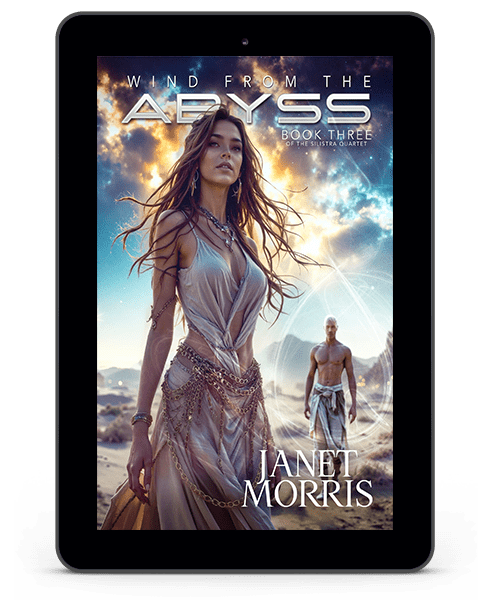
Wind From the Abyss
The Silistra Quartet Book 3
by Janet Morris
Genre: Dystopian Epic SciFi Fantasy Romance

Dystopia. Fantasy. Science fiction. Allegory. Political.
Wind from the Abyss is the third volume in Janet Morris’ classic Silistra Quartet, continuing one woman’s quest for self-realization in a distant tomorrow.
Aristocrat. Outcast. Picara. Slave. Ruler …. She is descended from the masters of the universe. To hold her he challenges the gods themselves.
Praise for Janet Morris’ Silistra Quartet:
“The amazing and erotic adventures of the most beautiful courtesan in tomorrow’s universe.” — Fred Pohl
“Engrossing characters in a marvelous adventure.” — Charles N. Brown, Locus Magazine.
“The best single example of prostitution used in fantasy is Janet Morris’ Silistra series.” — Anne K. Kahler, The Picara: From Hera to Fantasy Heroine.
This Perseid Press Author’s Cut Edition is revised and expanded by the author and presented in a format designed to enhance your reading experience with larger, easy-to-read print, more generous margins, and covers designed for these premium editions.
Wind from the Abyss starts with this . . .
“Since, at the beginning of this tale, I did not recollect myself nor retain even the slightest glimmer of such understanding as would have led me to an awareness of the significance of the various occurrences that transpired at the Lake of Horns, I am adding this preface, though it was no part of my initial conception, that the meaningfulness of the events described by “Khys’ Estri” (as I have come to think of the shadow-self I was while the dharen held my skills and memory in abeyance) not be withheld from you as they were from me. I knew myself not: I was Estri because the girl Carth supposedly found wandering in the forest stripped of comprehension and identity chose that name. There, perhaps, lies the greatest irony of all, that I named myself anew after Estri Hadrath diet Estrazi, who in reality I had once been. And perhaps it is not irony at all, but an expression of Khys’ humor, an implicit dissertation by him who structured my experiences, my very thoughts, for nearly two years, until his audacity drove him to bring together once more Sereth crill Tyris, past-Slayer, then the outlawed Ebvrasea, then arrar to the dharen himself; Chayin rendi Inekte, cahndor of Nemar, co-cahndor of the Taken Lands, chosen son of Tar-Kesa, and at that time Khys’ puppet-vassal; and myself, former Well-Keepress, tiask of Nemar, and lastly becoming the chaldless outlaw who had come to judgment and endured ongoing retribution at the dharen’s hands. To test his hesting, his power over owkahen, the time-coming-to-be, did Khys put us together, all three, in his Day-Keeper’s city — and from that moment onward, the Weathers of Life became fixed: siphoned into a singular future; sealed tight as a dead god in his mausoleum, whose every move brought him closer to the sum total, obliteration. So did the dharen Khys bespeak it, himself. . .”
“Morris, so good at giving us characters we can identify with, characters we can love and hate, strikes at the very heart of the human condition and the duality of humanity — both good and evil. Her prose is lean and spot-on, every word carefully chosen to enhance the milieu of her imaginary world and advance the plot, giving us access to the thoughts, emotions and machinations of the people whose stories she is presenting to us. Once again, she gives us a “thinking man’s” science fiction/fantasy that explores the nature of power and sexuality, and how they can be used, misused and abused. This is a brilliant, mature and very adult novel that will not only leave you thinking about your own place in the universe, but questioning the very nature of existence.” – Goodreads reviewer

I.In Mourning for the Unrecollected
The hulion hovered, wings aflap, at the window, butting its black wedge of a head against the pane. Its yellow eyes glowed cruelly, slit-pupiled. Its white fangs, gleaming, were each as long as my forearm.
I screamed.
Its tufted ears, flat against its head, twitched. Again and again, toothed mouth open wide, it battered at the window, roaring.
Once more I screamed and ran stumbling to the far wall of my prison. I pounded upon the locked doors with my fists, pressing myself against the wood. Sobbing, I turned to face it.
The beast’s ears flickered at the sound. Those jaws, which could have snapped me in half, closed. It cocked its head.
I trembled, caught in its gaze. I could retreat no farther. I sank to my knees, moaning, against the door frame.
The beast gave one final snort. Those wings, with a spread thrice the length of a tall man, flapped decisively, and it was gone.
When the hulion was no more than a speck in the greening sky, I rose clumsily, shaking, to collect the papers I had strewn across the mat in my terror. They were the arrar Carth’s papers, those he had forgotten in his haste to answer his returning master’s summons.
I knelt upon my hands and knees on the silvery pile, that I might gather the pages and replace them in the tas-sueded folder before Carth returned.
Foolish, I thought to myself, that I had so feared the hulion. It could not have gotten in. I could not get out: It could not get in. Once I had thrown a chair at that impervious clarity. The chair had splintered. With one stout thala leg, as thick as my arm, had I battered upon that window. All I had accomplished was the transformation of chair into kindling. The hulion, I chided myself, could have fared no better.
Hulions, upon occasion, have been known to eat man-flesh. Hulions, furred and winged, fanged and clawed, are the servants of the dharen who rules Silistra. I had had no need to fear. Yet, I thought as I gathered the arrar Carth’s scattered papers, hulions are fearsome. Perhaps if I had been able, as others are, to hear its mind’s intent, I would have felt differently. My fingers, numb and trembling, fumbled for the delicate sheets.
One in particular caught my eye. It was in Carth’s precise hand and headed: “Preassessment Monitoring of the Arrar Sereth. Enar Fourth Second, 25,697.”
I had met, once, the arrar Sereth. Upon my birthday, Macara fourth seventh, in the year ’696 had I met him, that night my child had been conceived. I had read of his exploits. He frightened me, killer of killers, enforcer for the dharen, he who wore the arrar: chald of the messenger. Sereth, scarred and lean and taut like some carnivore, who had loved the Keepress Estri, my namesake, and with her brought great change to Silistra in the pass Amarsa, 25,695 — yes, I had met him.
I sat myself down cross-legged on the Galeshir carpet, papers still strewn about, forgotten, and began to read:
The time is approximately three enths after sun’s rising, the weather clouded and cool, our position just south of the juncture of the Karir and Thoss rivers. I highly recommend that you look in upon the moment.
The arrar Sereth, on the brindle hulion Leir, touched his gol-knife. It was the first unnecessary movement he had made in over an enth. My presence, alongside upon a black hulion, disquieted him. The brindle, gliding at the apex of its bound, snorted. He touched its shoulder, and the beast, obedient, angled its wings and began its descent.
When its feet touched the grass, he set it at a grounded lope. 1 followed suit, bringing my black up to pace him.
Sereth regarded me obliquely. I, as he, served the dharen, he thought, and touched his hulion to a stop.
We had been riding all the night, up from Galesh, where I had met him with the two beasts. He had served the dharen, most lately, in Dritira. And before that, in the hide diet, and before that upon the star world M’ksakka had he dealt death and retribution at Khys’ whim. And dealt them successfully, though those tasks had been fraught with deadlier risk than a man might be expected to survive. His thought was wry, recollecting.
“How did you find M’ksakka?” I asked, to key him, to bring something else above the impenetrable shield he has constructed. My hulion rumbled at the brindle he rode, and that one answered.
“I will make a full report to Khys,” he said, slipping off the hulion’s back. “Let us rest them.”
I joined him where he lay upon the grass, staring at the sky.
“I missed this land,” he said. “The sky there is dark and ominous, always cloudy. M’ksakkan air stings eyes and lungs. Everything is covered with a fine black dust. I would not go again off the planet.”
“Perhaps he will not send you,” I conjectured.
He saw M’ksakka, and that seeing was colored by his distaste, both for the world and the work he had done there. The methods he had employed displeased his sense of fitness. The value of the M’ksakkan’s death was to him obscure. I saw the moment: the adjuster’s surprised eyes, wide and staring as Sereth’s fingers closed on his throat, around his windpipe,·the M’ksakkan’s clawing hand upon his wrist as he ripped out the man’s larynx, vocal folds dangling; then the blood, spurting, and the sound of the adjuster’s choking death. And I saw others he had killed, those who were anxious to try their skills against a real live Silistran. He had been hesitant to do so, but more hesitant to face an endless line of their ilk, so he had killed the first three. Again, his thoughts sank below readable level. The hulions lay quiet, lashing their tails. The clouds scudded heavy over the sun. A soft, drizzling rain commenced.
“The dharen is pleased with you,” I said.
He sat up, his mind absolutely inviolate. “What do you want, Carth?” He stared down at me. I lay perfectly still. He made no attempt to read me for his answer. He merely waited.
“A first impression. You are coming up for assessment.” I rose up. “We want to get some sense of you. Your mental health is now our concern.” He ducked his head, ripping grass from the sward. “You brought child upon that well woman in Dritira,” I prodded.
He saw her. In many ways she had reminded him of the Keepress. It had been passes since he had taken a woman. On M’ksakka there were females, but nothing he understood to be a woman. He had not couched many of them. And in hide diet, there were only forereaders. In Dritira, with that woman who reminded him of the Keepress, he had spent his long-pent seed. Four times he had used her, before she was more than a receptacle in his sight. And he had abused her, more than was his custom.
“Get me the forms. I will collect my birth-price,” he answered. He did not want the woman.
“You should take her. We have been considering her. She might yet make a forereader.”
“Then it is a pity she caught. From inferior blood can come only inferior stock.”
“Khys has asked me,” I told him, “to bid you welcome to any of the forereaders we hold in common at the Lake. Spawn from such a union surely would be possessed of talent. The bitterness you hold is out of proportion to the reality. We all, at one time or another, find there is something we want that we may not have.”
He did not answer me, but rose and went to his hulion. He thought of the Keepress Estri as one thinks of the dead, with acceptance; and then thought of his own life, and what compromises he has made to keep it. What he let me know, I have no doubt, will please you. What he did not — that is what concerns me. He allowed me nothing else for the duration of our return.
His shield, as you will find, is set lower and much farther into his deeper conscious than any I have encountered. Most of his processing must take place behind it. Deep-reading him is out of the question. He visualizes barely enough to verbalize his will. That he is functioning superbly is attested by his works. That he feels it to his advantage to serve us at present is a certainty. I worry over what might occur should he choose, eventually, not to serve us.
My formal recommendation is for a complete and detailed assessment. Also, I feel some attempt might be made to pacify him, in light of what he is fast becoming. Or perhaps even to eliminate him, lest he become, like Se’keroth, the weapon turned upon the wielder.
And it was signed Carth.
“Carth!” I gasped, as a dark hand snatched the sheet from my grasp. Still upon my knees, I twisted to see him. His dark eyes gleamed. He ran his hand through his black curls.
“Did you find this informative, Estri?” he asked, towering over me, the paper crumpled in his fist. Carth was furious.
I dared not answer. I started to my feet.
“Pick these up!” he commanded, pointing.
I scurried to obey him, scrambling for the leaves strewn upon the web-work carpet, my stomach a knot. Once before, I had seen Carth this agitated, when I had written for him a certain paper. And he had called it audacious, and destroyed it. I finished, and rose to my full height, handing the tas envelope to him. My head came to his shoulder. He looked down at me, stern-faced.
“You were ill-advised to do this,” he said. “The dharen is not pleased with you. This” — he threw the crumpled sheet across the room — “will only aggravate matters. You had best make some effort to placate him.”
“What do you mean?” I demanded. “Has he taken some sudden interest in me?” I had seen the dharen precisely three times since I had come to reside at the Lake of Horns: the night he had gotten me with child, the day following, and once while I lay near death when the unborn had driven me to seek it. He had not been at the Lake of Horns when I bore his he-beast into the world. I had cried out for him during that premature and extended labor. He had been unavailable. Now, nearly eight passes later, he had returned.
“Do not be insolent!” Carth’s voice rasped as his palm cuffed my face to one side. Tears in my eyes, I put my hand to my cheek. It was what I had thought, not what I had said, that had brought me chastisement. Shaking my head, I backed away from him. Though I had known Carth a telepath, a surface-reader, rarest of Silistran talents, never had he shown his skills before me, one who neither spoke nor heard the tongues of mind.
“Estri, come here.”
I went to him, my hand trailing from my cheek to the warm, pulsing band locked about my throat.
When I stood before him, he lifted my face, his hand under my chin, so I must look into his eyes.
“He is very angry, child. You must realize that what you think is as audible to him as what you say. I know it was not malicious, that you read what you found. Forget it, if you can. Concentrate on what lies before you.” He patted my back, all the anger gone out of him.
“I do not want to see him,” I said, toying with the ends of my copper hair, grown now well below mid thigh.
Carth pursed his lips. “You have no choice. He will see you in a third-enth. Make ready.” And he turned and strode through the double doors that adjoined my prison to Khys’ quarters. Khys, my couch-mate, was again in residence. The dharen of all Silistra, back from none knew where, would again rule from the Lake of Horns.
Make ready, indeed, I thought, combing my hair. I had only the white, sleeveless s’kim I wore; thigh-length, of simple web-cloth. My jewelry was the band of restraint at my throat. I retied the garment upon my hips. Throwing my hair back, I regarded myself in my prison’s mirrored wall. My body, copper-skinned, lithe, only shades lighter than my thick mane, postured at me, arrogant. I had thought, for a time, that the he-beast had destroyed it, but such had not been the case. Exercise had given its grace and firmness back to me. My legs are very long, my waist tiny, hips slim. Pregnancy had altered me little. My breasts were still high and firm, my belly flat and tight. Good enough for him, surely. I widened my eyes suggestively, then stuck my tongue out at her. She made a face back. I grinned and wondered why I had done so, turning from the wall that ever showed me the boundaries of my world.



Best selling author Janet Morris began writing in 1976 and published more than 30 novels, many co-authored with her husband Chris Morris or others. She contributed short fiction to the shared universe fantasy series Thieves World, in which she created the Sacred Band of Stepsons, a mythical unit of ancient fighters modeled on the Sacred Band of Thebes. She created, orchestrated, and edited the Bangsian fantasy series Heroes in Hell, writing stories for the series as well as co-writing the related novel, The Little Helliad, with Chris Morris. She wrote the bestselling Silistra Quartet in the 1970s, including High Couch of Silistra, The Golden Sword, Wind from the Abyss, and The Carnelian Throne. This quartet had more than four million copies in Bantam print alone, and was translated into German, French, Italian, Russian and other languages. In the 1980s, Baen Books released a second edition of this landmark series. The third edition is the Author’s Cut edition, newly revised by the author for Perseid Press. Most of her fiction work has been in the fantasy and science fiction genres, although she has also written historical and other novels. Morris has written, contributed to, or edited several book-length works of non-fiction, as well as papers and articles on nonlethal weapons, developmental military technology and other defense and national security topics.
Janet said: ‘People often ask what book to read first. I recommend “I, the Sun” if you like ancient history; “The Sacred Band,” a novel, if you like heroic fantasy; “Lawyers in Hell” if you like historical fantasy set in hell; “Outpassage” if you like hard science fiction; “High Couch of Silistra” if you like far-future dystopian or philosophical novels. I am most enthusiastic about the definitive Perseid Press Author’s Cut editions, which I revised and expanded.’
Website * Facebook * Twitter * Instagram * Bookbub * Amazon * Goodreads

Follow the tour HERE for special content and a giveaway!
Apr 8
Kickoff at Silver Dagger Book Tours
Apr 9
Word Processor, Romance, Cats, Kids and Creed
Apr 10
Apr 11
Stormy Nights, Books and Blogging
Apr 12
Book Bites….with a side of coffee
Apr 13
Apr 14
Books all things paranormal and romance
Apr 15
Book Reviews by the Reluctant Retiree
Apr 16
Tina Donahue Books – Heat with Heart
Apr 17
Apr 18
Apr 19
WMC Book Corner – YouTube channel
Apr 20
Apr 21
Apr 22

Looking for more awesome book tours and giveaways to enter?
Check out the rest of the Current Tours!













I enjoy getting to know your book.
I like the cover art. Looks great. Sounds like a good story.
Looks very exciting
I would love to read this! It’s one of my favorite genres
Lovely cover!
Looks like a good read
I enjoyed reading this well done excerpt for this great series!
Thank you for sharing it.
this sounds like a great read
I love the cover.
This sounds like a great Dystopian Epic SciFi Fantasy Romance book. I like the cover.
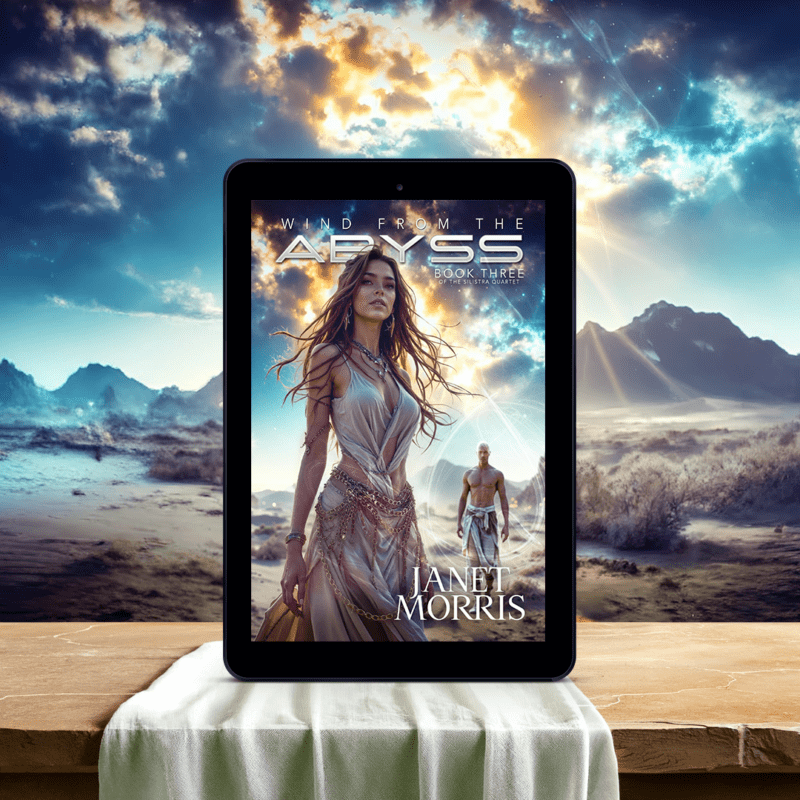
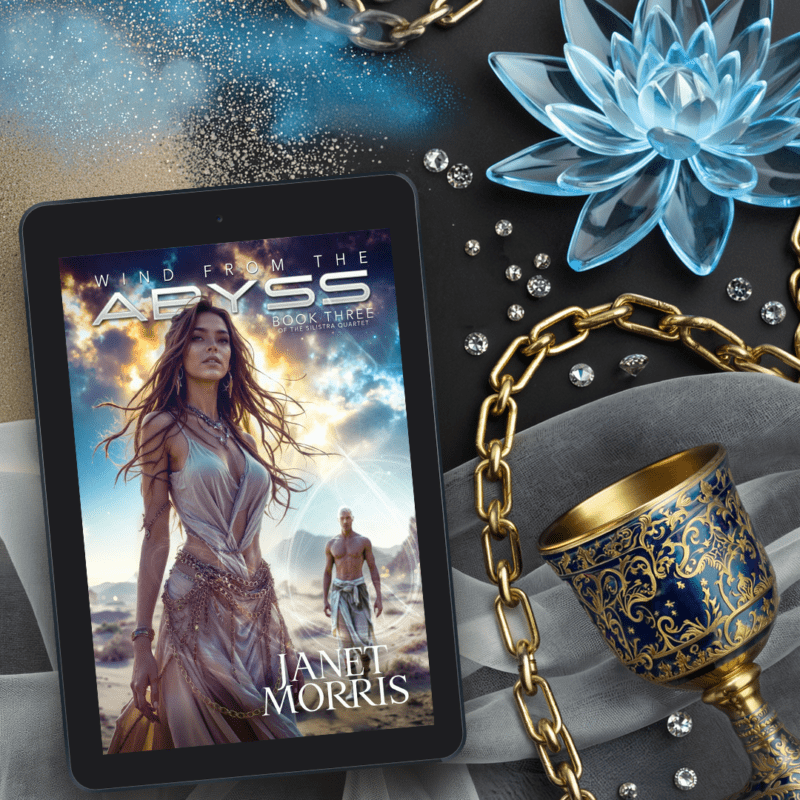
Another good cover, that certainly shows a woman not exactly bent under the weight of what is happening to her.
I’m drawn to Wind from the Abyss because it blends dystopian sci-fi, fantasy, and political intrigue with a powerful heroine on a journey of self-discovery.
To commenter Thomas – Thank you. Your comment nails it. There’s a lot more here than meets the eye at first glance. Janet had a huge moral imagination and loved to tackle issues in the context of her stories. So, thanks again and if you’d like to know more you can contact me at Chris@theperseidpress.com.
Awesome cover
What a fascinating book! Great cover and excerpt. I’d love to read more.
Hope the book is a great read!
I like the cover, the dress is stunning
Looks like a good read
This sounds like my kind of book!!!
I am so loving the cove of this book.
It looks like a good read.
This is an interesting combination of genres. I love the cover!
Sounds like a great book.
I love the cover and the excerpt.
I like the book details.
I like the cover. You have two beautiful people on the cover.
This sounds like an interesting book and I also like the cover.
looks like a fun one.
The excerpt is interesting. Thank you for sharing it.
I really love the book cover. It matches the theme of the book really well.
The science fiction romance looks fun to read and I like the cover art.
The cover looks stunning!
Looking forward to reading this.